Wildfire Smoke at Home in Southwest Washington: Filtration Plan
Prepare a cleaner-air room, choose HVAC filtration your system can handle, and avoid last-minute products that create new safety risks.
Source-reviewed homeowner guide
Quick takeaways
- ✓Buy compatible filters before smoke season.
- ✓Use MERV 13 only if the system supports it.
- ✓Plan a cooler cleaner-air room.
- ✓Avoid ozone and indoor combustion.
Prepare before smoke reaches the forecast
Washington DOH says wildfire smoke season typically starts in July or August but may begin as early as May. Supplies can sell quickly. Before the season, identify one room with closable doors and windows, inspect weatherstripping, replace damaged seals where appropriate, and confirm the home’s cooling and ventilation options.
This guide applies across Vancouver, Ridgefield, Camas, La Center, Woodland, and Battle Ground. Actual smoke varies by event; monitor AirNow and Washington smoke information rather than assuming one city is clear because another is not.
Use filtration the system can support
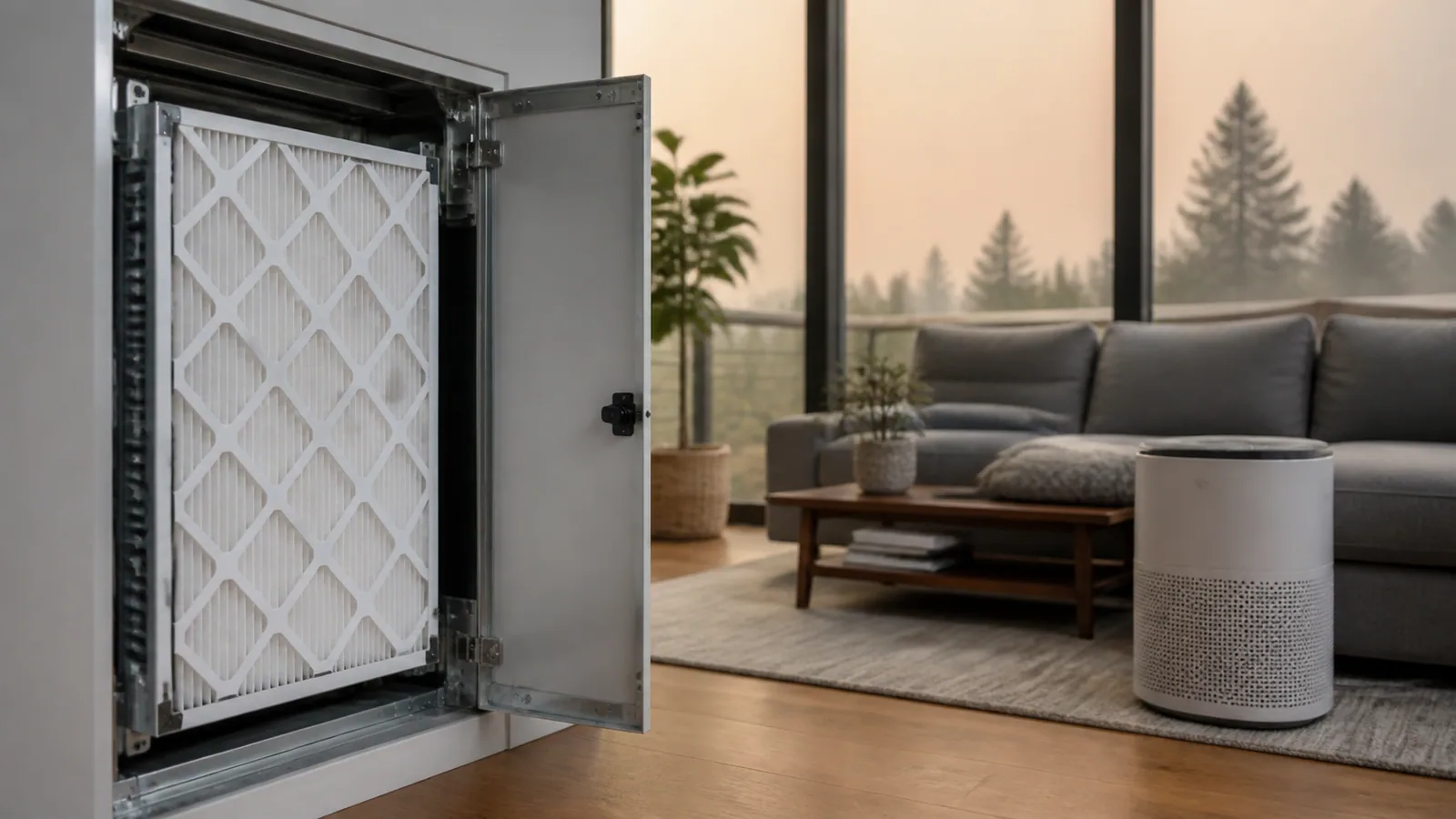
DOH recommends a particle-removal HVAC filter and discusses MERV 13 or the highest rating the system can handle. A higher number is not automatically safe for every blower, filter slot, or duct system. Check the equipment manual and ask an HVAC professional when resistance, fit, or airflow is uncertain. Use the deepest compatible pleat and install it in the correct direction.
A portable HEPA air cleaner should be appropriately sized for the room and kept unobstructed. Avoid ozone-generating devices. Keep spare filters sealed and record installation dates.
Balance clean air, heat, and combustion safety
Closing windows reduces smoke entry but can increase indoor heat. Plan cooling, hydration, and relocation for vulnerable occupants. Never use an unvented combustion appliance, grill, or generator indoors. Maintain carbon-monoxide alarms and keep outdoor air intakes configured according to equipment and professional guidance.
During smoky periods, reduce particle-generating indoor activities such as frying, candles, smoking, and aggressive dry dusting. Use damp cleaning and a HEPA vacuum if appropriate.
Write a maintenance and response card
Record filter size and rating, cleaner-room location, portable unit capacity, where replacement filters are stored, air-quality links, medication and contact needs, and the conditions that trigger leaving. After the event, inspect and replace loaded filters as the manufacturer recommends; do not wash a disposable filter.
Homeowner questions
Should every HVAC system use MERV 13?+
Use MERV 13 or the highest efficient filter the specific system can safely support. Confirm fit, airflow, and manufacturer guidance.
Is a portable air cleaner enough for the whole house?+
Usually it is sized for a defined room or area. Match clean-air delivery to room volume and keep doors and windows managed.
Can I open windows when smoke smell improves?+
Check current outdoor PM2.5 or AQI first. Smell is not a reliable particle measurement.
Are ionizers and ozone machines recommended?+
Avoid devices that intentionally generate ozone. Select filtration that removes particles without adding a respiratory irritant.
Primary sources
Official requirements can change. Confirm the current rule for your address and project with the named authority.